
Annual Compliances for Private Limited Companies
Maintain Active Status - Ensure your company remains compliant and avoids dormant classification
Avoid Heavy Penalties - Timely filing prevents Rs.100/day additional fees and other penalties
Build Credibility - Enhance trust with investors, customers, and stakeholders through transparency
Better Financial Management - Keep financial records updated for informed decision-making
Annual Compliance for Private Limited Companies
Fill Out the Form Now – Let FileSure Keep Your Business Compliant and Penalty-Free!
Private Limited Company’s Annual Compliance An Overview
As per The Companies Act, 2013, every Private Limited Company has to annually convene an Annual General Meeting, file Return of Deposit, its Audited Financial Statements and Annual Return with the Registrar of Companies.
Every director of the company is required to complete their KYC and file the e-form annually to avoid penalties.
Private Limited company have to mandatorily get its annual accounts examined by an independent auditor called the Statutory Auditors. It is done to ensure that the annual accounts show a true and fair view of the company’s financial position.
In Addition to the compliance under The Companies Act, 2013 - Private companies must file Income Tax Return with the Income Tax department for each financial year.

Advantages of Company’s Annual compliance
Credibility and Transparency
The company provides clear and accurate information about its performance, which helps build trust, gain credibility and promotes transparency with investors, customers, stakeholders and government authorities.
Maintain Active Status
If a company fails to file Financial Statements (AOC-4) and Annual Returns (MGT-7 or MGT-7A) for continuous 2 financial years, ROC may classify the company's status as “inactive” or “dormant” and ROC may also strike off the company.
Avoidance of Penalties
Every company must ensure timely compliance by filing the Return of Deposits (DPT-3), completing Director’s KYC (DIR-3 KYC or Web KYC), holding the Annual General Meeting (AGM), and filing Financial Statements (AOC-4), Annual Returns (MGT-7 or MGT-7A). Timely compliance will help companies avoid hefty penalties.
Better Financial Management and Attracts Investment
Regular compliance ensures the company's financial records are up to date, helping in better decision-making and financial planning. Companies with strong compliance records are more attractive to investors.
Documents required for annual compliance
- Certificate of Incorporation
- MOA and AOA of the company
- Details of the Auditors
- Duly signed Audited Financial Statements and Audit Report
- Director’s Report
- List of Shareholders, Debenture Holders and Directors.
- Minutes of Board Meetings and General Meetings
- DSC of authorised directors

Due date for Return of Deposits for FY 23-24
- Every company (other than a government company) that has outstanding receipt of money or loans, whether classified as deposit or not under the Companies (Acceptance of Deposits) Rules, 2014 must file Form DPT-3 annually.
Due dates for companies Incorporated on or before 31st December, 2023
Due date for Directors KYC for FY 23-24
- As per the Companies Act, 2013, every Director holding a Director Identification Number (DIN) must complete the KYC (Know Your Customer) process annually by filing Form DIR-3 KYC or Web KYC.
- This ensures that the Director’s details, such as address, email, and contact information, are updated with the Ministry of Corporate Affairs (MCA).
 If the Director fails to file Form DIR-3KYC or Web KYC before the due date, he will be liable for a penalty of Rs.5,000/-.
Due date for Convening Annual General Meeting for FY 23-24
- The Annual General Meeting (AGM) must be held within 6 months from the end of the financial year, i.e., by 30th September 2024, OR within 15 months from the date of the last AGM, whichever is EARLIER.
- The first AGM, however, must be held within 9 months from the end of the financial year. Therefore, the first AGM should be conducted on or before 31st December 2023.
Annual compliance for FY 23-24
Companies incorporated
on or before 31st December 2023
They need to prepare their Financial Statements, Annual Return for the 2023-2024 financial year. They must file their Financial Statements in e-Form AOC-4 and their Annual Returns in e-Form MGT-7 or MGT-7A on the due dates mentioned below.
Companies incorporated
on or after 1st January 2024
They can prepare their Financial Statements for up to 15 months. Their financial year will start from the date of incorporation and end on March 31, 2025. These companies must file their Financial Statements in e-Form AOC-4 and file their Annual Returns in e-Form MGT-7 or MGT-7A in the following year.
Information about AOC-4 form
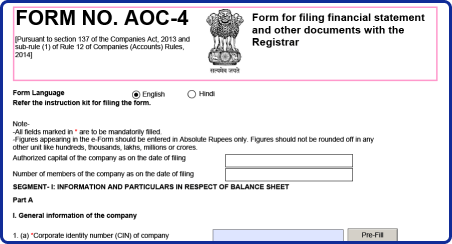
- AOC-4 is a form that must be filed by every company to submit its Financial Statements to the Registrar of Companies (ROC).
- Every company must file this form within 30 days from the conclusion of the Annual General Meeting (AGM).
- The form should be signed by the Director and the Chief Financial Officer (CFO), if applicable, or by the Company Secretary.
- Required attachments include the Financial Statements, Board Report, Auditors Report, Statement of Subsidiaries/Associate Companies, and if applicable, CSR Report.
Information about MGT-7 or 7A form
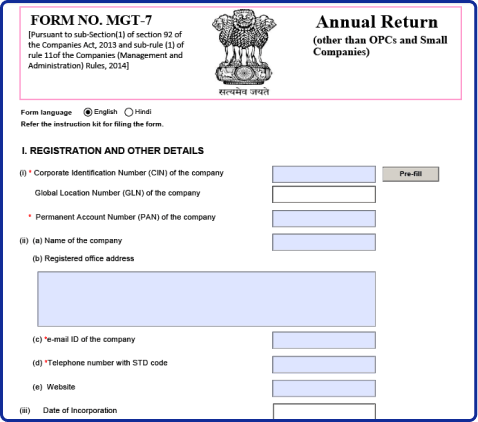
- MGT-7 or 7A is the form through which companies shall file their Annual Return with the Registrar of Companies (ROC).
- This form contains details about the company’s shareholders, directors, key managerial personnel, indebtedness, corporate governance disclosures, and other statutory information.
- It must be filed within 60 days from the date of the Annual General Meeting (AGM) or from the due date if the AGM is not held.
- MGT-7A is a simplified version of MGT-7, applicable for One Person Companies (OPCs) and Small Companies, to make the filing process easier for them.
- The form must be digitally signed by a Director and the Company Secretary, or if no Company Secretary is present and by a Director.
- Required attachments include list of shareholders, list of debenture holders, list of directors and if applicable MGT-8.
Due date for companies Incorporated on or before 31st December, 2022
Due date for companies Incorporated on or after 1st January, 2023 to 31st December, 2023
Process of Annual compliances
Step- 1: Statutory Audit and Auditor’s Report
The statutory Auditor of the company is responsible for examining the company’s annual accounts to ensure they provide a true and fair view of the company’s financial position.After conducting the audit,the auditor prepares the Audit Report and provides his remarks in the report.
Step- 2: Presentation and Approval of Financial Statements to Board of Directors
The Audit Report and Financial Statements are presented to the company’s Board of Directors during a Board Meeting. The Board reviews the Audit Report and, if satisfied, approves the Financial Statements in the same meeting. These Financial Statements are signed by auditor, Board of Directors and Key Managerial Person, if any.
Step- 3: Preparation of the Board Report
In addition, a Board Report is prepared by the Directors, which contains important details of the company such as its financial position, changes in the administration policies, any changes in shareholding or debenture holdings, changes in accounting policies, the number of Board Meetings held, details of auditors, and any Related Party Transactions, etc. This report is signed by the Board of Directors.
Step- 4: Deciding the Date for the AGM
In this Board Meeting, the directors also approve the date for convening the Annual General Meeting (AGM). Following this, a Notice for the AGM, along with the Auditor’s Report, Audited Financial Statements, and Board Report, is sent to the shareholders/members of the company. This ensures that the shareholders have all relevant information to make an informed decision
Step- 5: Holding of AGM and transacting business
At an Annual General Meeting (AGM), shareholders or members review the company’s performance and transact ordinary business matters, which includes approving the Financial Statements, Auditor’s Report, and Board of Director’s Report. They may also declare dividends, appoint or regularise Directors, and appoint Auditors. If necessary, special business may also be transacted.
Step- 6: Filing of AOC-4 and MGT-7A
Within 30 days from the conclusion of the AGM, the company is required to file AOC-4 with the Registrar of Companies (ROC) for the submission of Financial Statements. Additionally, within 60 days from the conclusion of the AGM, the company must file MGT-7 or MGT-7A (depending on its category) to submit the Annual Return.


Stay Compliant, Avoid Penalties – Get Started with FileSure!
Now that you’ve read the process, it’s time to take action. Click the button to get started with FileSure and avoid penalties. We’ll ensure your Private Limited Company stays compliant and penalty-free!
Penalty for non-filing of AOC-4 and MGT- 7 or 7A form
If the company fails to file Form AOC-4 and MGT-7/7A before the due date, they will be liable for an additional fee of Rs.100/- per day till the date of filing.


Bhagyashree Katkar Author Compliance Officer at 
Bhagyashree Katkar is a Compliance Officer at Filesure India Private Limited with over 2.5 years of experience in Corporate Compliance and 21 months in Indirect Tax. An LLB graduate, she specializes in the Companies Act, 2013, Trade Mark, and NCLT matters. Bhagyashree has been involved in secretarial audits for MNCs and conducted due diligence for various companies. Currently, she manages compliance for multiple clients at Filesure.